

Mobile Shop ERP vs Traditional ERP: What Should You Actually Run Your Shop On?
Why purpose-built mobile shop ERP usually beats a generic, implementation-heavy traditional ERP for phone retailers.
Quick Summary — Phoneo vs Traditional ERP in 30 seconds
For a mobile phone shop, a purpose-built Mobile Shop ERP is almost always the better choice over a traditional ERP — it already understands IMEI stock, second-hand phones and repairs, and gets you billing in days instead of the weeks or months a traditional ERP implementation typically takes.
Key takeaways:
- Traditional ERP is generic business software (accounting, inventory, HR modules) meant to be customised for any industry — including yours, if you pay for that customisation.
- Mobile Shop ERP is purpose-built specifically for phone retail — IMEI tracking, second-hand phones, repairs and variants are already built in, not add-ons.
- Traditional ERP implementations often take weeks to months, involve consultants, and cost significantly more upfront than a ready-made mobile shop tool.
- A traditional ERP's inventory module usually has no concept of an IMEI number, a phone condition grade, or a repair job card.
- For most single or multi-branch mobile shops, a purpose-built Mobile Shop ERP like Phoneo gets you productive in days, not months.
"ERP" (Enterprise Resource Planning) originally meant large, generic software systems — covering accounting, inventory, HR, manufacturing and more — built to be customised for almost any industry. Traditional ERP systems like Tally, Marg ERP, SAP Business One or Odoo follow this model: broad, flexible, and configured by you (or a paid implementation partner) to fit your business.
A Mobile Shop ERP takes the opposite approach — instead of a blank, configurable system, it comes pre-built specifically for how a mobile phone shop actually works: IMEI-wise inventory, second-hand phone grading, variant and colour management, repair job cards, and GST billing designed around retail counters, not distribution ledgers.
This comparison looks at what that difference actually means in practice — implementation time, cost, and whether your team is fighting the software or working with it from day one.
Quick comparison at a glance
| Phoneo Seller | Traditional ERP | |
|---|---|---|
| Best for | Mobile phone shops (single or multi-branch) | Large or multi-industry businesses needing deep customisation |
| Time to start billing | ✅ Same day to a few days | ❌ Weeks to months (implementation project) |
| IMEI-wise inventory out of the box | ✅ Built-in | ❌ Needs custom development |
| Second-hand phone workflows | ✅ Built-in | ❌ Not a standard module |
| Repair job cards | ✅ Built-in | ❌ Custom module or third-party add-on |
| Implementation cost | ✅ Low, self-serve onboarding | ❌ Often significant (consultants, customisation) |
| Staff learning curve | ✅ Minutes to hours | ❌ Days of training, often ongoing |
| GST billing | ✅ Retail-counter-ready | ✅ Available, but needs configuration |
| Deep multi-module customisation (HR, manufacturing, etc.) | ❌ Not the focus | ✅ Strong, if you need it |
| Cloud & mobile access | ✅ Cloud-first | ⚠️ Depends heavily on the specific ERP |
What is Phoneo Seller?
Phoneo Seller is an example of a purpose-built Mobile Shop ERP — a billing, inventory and CRM platform built exclusively for mobile phone retailers in India, with no customisation project required. It tracks stock by IMEI/serial, manages new and second-hand devices, records customer credit (udhari), runs repair job cards, and gives your shop a QR-linked online storefront, ready to use from day one.
Key features:
- IMEI/serial-based stock tracking for new and second-hand phones, built in — not configured
- Variant and colour-wise inventory built for handset models
- GST & Non-GST billing with WhatsApp invoice sharing
- Second-hand purchase, exchange and buyback workflows with ID-proof vault
- Repair and job-card management
- Customer ledger, udhari and IMEI-linked purchase history
- Unlimited staff with role-based permissions and salary management
- Free digital storefront with phone specs, images and QR code
- Multi-branch management from one dashboard
A Mobile Shop ERP like Phoneo skips the implementation project entirely — the mobile-retail logic is already built in.
What is Traditional ERP?
A traditional ERP is broad, general-purpose business software — think Tally, Marg ERP, SAP Business One, Odoo, or similar systems — designed to serve many industries through configuration and customisation. It typically covers accounting, generic inventory, purchase/sales, and sometimes HR or manufacturing modules, implemented by an internal team or a paid partner to fit your specific business.
Key features:
- Deep, flexible accounting and financial reporting
- Generic inventory modules that can be configured for many industries
- Multi-module coverage (HR, manufacturing, CRM, and more, depending on the ERP)
- Established vendor and implementation-partner ecosystems
- Scales to complex, large multi-department organisations
A traditional ERP can technically be configured for mobile retail — but the IMEI tracking, second-hand workflows and repair job cards you need don't exist out of the box; someone has to build them.
Phoneo vs Traditional ERP: feature-by-feature comparison
Setup, implementation & time to value
| Feature | Phoneo | Traditional ERP |
|---|---|---|
| Time to start billing | ✅ Same day to a few days | ❌ Weeks to months, typical implementation project |
| Requires a consultant/implementation partner | ✅ Not needed | ❌ Common, especially for customisation |
| Pre-built for mobile retail workflows | ✅ Yes | ❌ Built generically, customised per business |
| Staff learning curve | ✅ Minutes to hours | ❌ Days of training, ongoing support often needed |
This is the core difference — a traditional ERP is a platform you build your mobile shop's workflow on top of; a Mobile Shop ERP already has that workflow built in. See smart inventory management.
IMEI & phone-specific inventory
| Feature | Phoneo | Traditional ERP |
|---|---|---|
| IMEI / serial number per device | ✅ Built-in | ❌ Custom development required |
| Duplicate IMEI detection | ✅ Real-time alert | ❌ Would need to be custom-built |
| Variant / colour tree for handsets | ✅ Phone-aware | ❌ Generic item variants only |
| Second-hand phone grading & exchange | ✅ Built-in | ❌ Not a standard module |
Traditional ERPs weren't designed with a phone's specific identifiers in mind — that logic has to be added, at a cost, if it's possible at all. See IMEI-based stock audit.
Billing, GST & invoicing
| Feature | Phoneo | Traditional ERP |
|---|---|---|
| GST billing (CGST/SGST/IGST) | ✅ Retail-ready | ✅ Available, needs setup |
| Fast counter billing | ✅ Simple UI, built for retail | ⚠️ Often built for accounting, not counter speed |
| WhatsApp invoice sharing | ✅ Built-in | ⚠️ Custom integration, if available |
| Repair job invoice | ✅ | ❌ Custom module |
Both can technically produce a GST invoice — the difference is whether that invoice screen was designed for a phone shop counter or a general ledger. See GST billing & invoice generator.
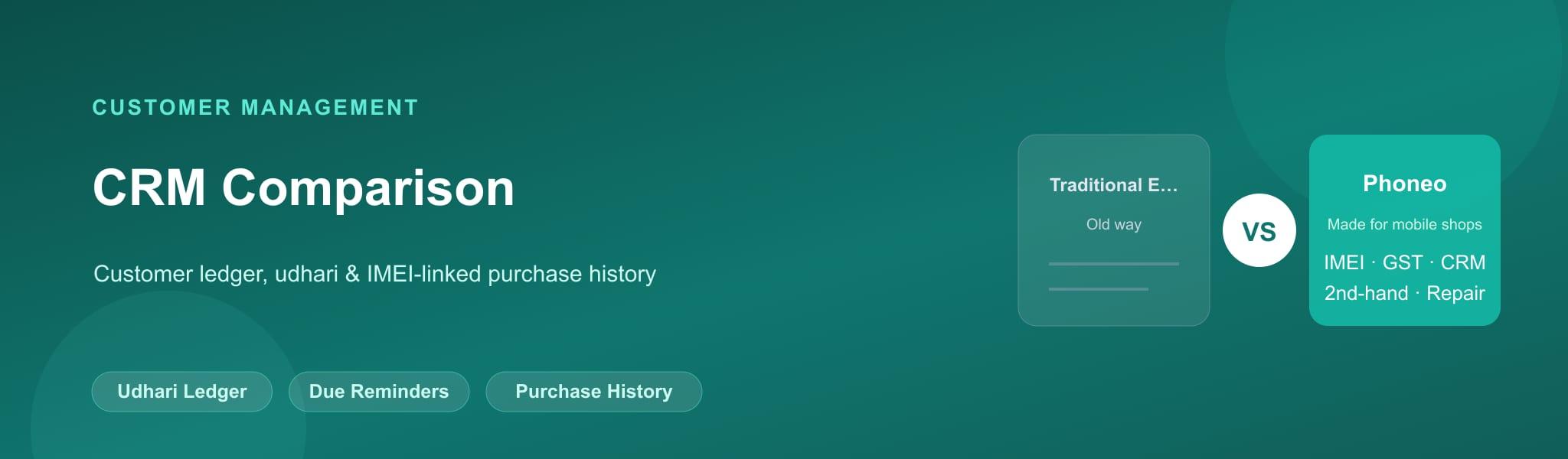
Customer management & staff
| Feature | Phoneo | Traditional ERP |
|---|---|---|
| Customer ledger (udhari) | ✅ Shop-friendly | ✅ Accounting-style ledger |
| IMEI-linked purchase history | ✅ | ❌ Not a standard capability |
| Staff roles for a shop counter | ✅ Custom roles + salary | ✅ User rights, often complex to configure |
| Multi-branch management | ✅ Built-in dashboard | ✅ Available, typically a larger setup |
Traditional ERP user-permission systems are powerful but usually designed for accounting teams, not a shop counter with rotating staff. See credit & payment tracking.
Where traditional ERP genuinely wins
| Feature | Phoneo | Traditional ERP |
|---|---|---|
| Multi-department coverage (HR, manufacturing, etc.) | ❌ Not the focus | ✅ Strong, where relevant |
| Deep, fully custom workflows | ⚠️ Fixed to mobile retail | ✅ Can be built to spec |
| Large enterprise scale | ⚠️ Built for shops, not conglomerates | ✅ Designed for it |
If your business genuinely spans manufacturing, multi-department operations, or needs fully bespoke workflows beyond retail, a traditional ERP's flexibility is a real advantage.
Pricing comparison
| Phoneo | Traditional ERP | |
|---|---|---|
| Model | SaaS subscription, ready to use | License + implementation/customisation cost |
| Free tier | ❌ (7-day free trial) | ❌ Rare, and implementation cost applies regardless |
| Typical setup cost | ✅ Free guided onboarding | ❌ Can be substantial, depending on customisation |
| Built for mobile shops | ✅ Yes, out of the box | ❌ Only after custom configuration |
Traditional ERP pricing varies enormously by vendor and how much customisation you need — it's rarely a fixed, predictable cost the way a mobile shop SaaS subscription is. See Phoneo pricing and plans.
Where Phoneo beats Traditional ERP
⚡ Fast time to value
Start billing in days, not the weeks-to-months typical of an ERP implementation.
📱 IMEI-native from day one
No custom development needed — IMEI tracking is already built in.
🔄 Second-hand & repair ready
Workflows a generic ERP simply doesn't include as standard.
💰 Predictable, lower cost
No implementation-partner fees or open-ended customisation budgets.
🎓 Minimal training
Shop staff learn it in minutes because it already matches how they work.
🏪 Free QR storefront
A mobile-spec online store included — not a separate module to build.
Where Traditional ERP beats Phoneo
🏭 Multi-department depth
Genuine strength for businesses spanning HR, manufacturing, and more.
🛠️ Full customisation
Can be built to match almost any bespoke workflow, at a cost.
🏢 Enterprise scale
Designed for large, complex organisations beyond a single retail vertical.
✅ Who should choose Phoneo?
- You run a mobile phone shop — single branch or multiple branches
- You want to be billing and tracking IMEI stock within days, not months
- You don't want to pay for a custom implementation project
- You buy, exchange or sell used phones and need ID-proof records
- You want repair job cards and a mobile-spec storefront included
✅ Who should choose Traditional ERP?
- You run a large, multi-department organisation beyond retail
- You need deep, fully bespoke workflows a pre-built tool can't offer
- You already have (or plan to hire) an implementation team
Decision matrix: which one should you pick?
| Your situation | Best choice |
|---|---|
| Single mobile phone shop | Mobile Shop ERP (Phoneo) |
| Multi-branch mobile phone retail chain | Mobile Shop ERP (Phoneo) |
| Second-hand / exchange phone business | Mobile Shop ERP (Phoneo) |
| Large multi-industry conglomerate | Traditional ERP |
| Business needing HR, manufacturing and retail in one system | Traditional ERP |
Final verdict
For the overwhelming majority of mobile phone shops, a purpose-built Mobile Shop ERP beats a traditional ERP — you get IMEI tracking, second-hand phone workflows, and repair job cards already built in, with billing running in days instead of the weeks-to-months a traditional ERP implementation typically takes. Traditional ERP still makes sense for large, multi-department organisations that need deep, fully bespoke workflows beyond a single retail vertical.
Frequently asked questions
Q: What is a Mobile Shop ERP?
A Mobile Shop ERP is business software built specifically for mobile phone retailers, with IMEI-wise inventory, second-hand phone workflows, repair job cards and GST billing already built in — no customisation project required.
Q: What is a traditional ERP?
A traditional ERP is generic, multi-industry business software (like Tally, Marg ERP, SAP Business One or Odoo) covering accounting, inventory and other modules, designed to be configured or customised for almost any business, including retail.
Q: Is a traditional ERP suitable for a mobile shop?
It can be used for GST billing and basic accounting, but IMEI tracking, second-hand phone handling and repair job cards aren't standard modules — they would need custom development, adding cost and time.
Q: How long does it take to implement a traditional ERP?
Traditional ERP implementations commonly take weeks to months, especially when custom modules or industry-specific workflows are needed, often involving a consultant or implementation partner.
Q: How long does it take to start using a Mobile Shop ERP?
A purpose-built Mobile Shop ERP like Phoneo typically has you billing and tracking stock within a day or a few days, since the mobile-retail workflow is already built in.
Q: Is a Mobile Shop ERP cheaper than a traditional ERP?
Usually yes for a phone retailer, because there's no implementation-partner fee or custom-development cost — you're paying for software that already fits your business, not for building that fit yourself.
Q: Can a traditional ERP track IMEI numbers?
Not out of the box. Some traditional ERPs can be customised to store serial numbers, but this typically requires custom development rather than being a ready-made feature.
Q: Does a traditional ERP handle second-hand phones?
Not natively. Second-hand purchase, condition grading, and exchange workflows are specific to mobile retail and aren't standard modules in general-purpose ERP systems.
Q: Why should a mobile shop avoid a traditional ERP?
The main risks are long implementation time, higher cost from customisation, and a steeper learning curve for shop staff — none of which are necessary when purpose-built mobile shop software already exists.
Q: When does a traditional ERP make more sense than a Mobile Shop ERP?
When your business spans multiple departments beyond retail — like manufacturing, HR, or complex multi-entity accounting — a traditional ERP's flexibility and depth can be worth the implementation investment.
Q: Is Phoneo an example of a Mobile Shop ERP?
Yes. Phoneo is built specifically as a Mobile Shop ERP — combining IMEI inventory, GST billing, second-hand phone workflows, repairs, staff management and reporting into one ready-to-use platform.
Q: Can a Mobile Shop ERP scale to multiple branches?
Yes. Phoneo supports multi-branch management from a single dashboard, without needing the larger implementation typically required to scale a traditional ERP across locations.
Q: Does a Mobile Shop ERP replace an accountant?
No. A Mobile Shop ERP like Phoneo handles retail-level billing, inventory and reports; many shops still use an accountant or a broader accounting tool for full financial statements.
Q: Is training required to use a Mobile Shop ERP?
Minimal. Because a Mobile Shop ERP already matches how a phone shop actually works, most staff learn the core workflows — billing, stock, repairs — in minutes rather than days.
Q: Which is better for a growing mobile retail chain?
A Mobile Shop ERP is usually better for a growing phone retail chain specifically, since it scales through built-in multi-branch features rather than requiring a fresh implementation project at each stage of growth.
If you run a mobile shop and you're tired of tools that weren't built for your business, Phoneo is the answer.