

How to Trace a Stolen Phone by IMEI: Complete Guide for Mobile Shop Owners (2026)
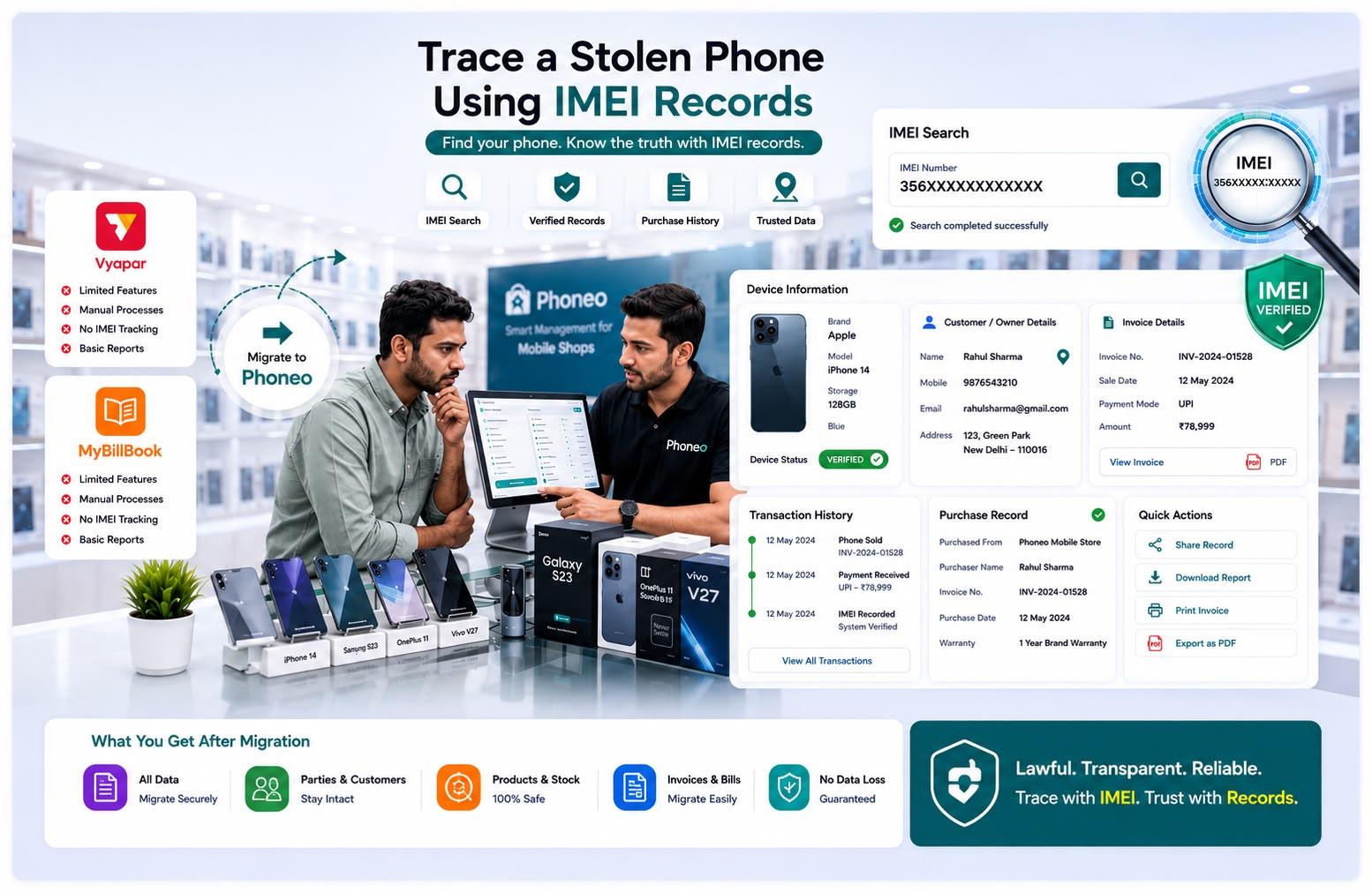
A stolen mobile phone can often be identified and tracked using its IMEI number. Mobile networks and authorities use the IMEI to block or trace a handset, so it is the first thing anyone needs after a device goes missing.
But tracing does not stop with the customer. For a mobile shop — especially a second-hand mobile shop — keeping accurate IMEI and ID records for every purchase and sale is what protects your business from disputes, fraud, and inventory confusion.
Quick answer: can you trace a stolen phone by IMEI?
Yes. A stolen phone is traced using its 15-digit IMEI (International Mobile Equipment Identity) number. Mobile operators and government authorities can block or trace the exact handset by its IMEI. For a mobile shop, recording every IMEI with the seller's ID proof and purchase details builds a clear ownership trail that protects your business.
What is an IMEI number?
Every mobile phone has a unique 15-digit IMEI number assigned by the manufacturer. Think of it as the phone's permanent identity.
Unlike a SIM card, which you can change, the IMEI stays with the handset for its whole life. It separates one device from another, even when two phones share the same brand, model, colour, and storage.
You can usually find the IMEI in these ways:
- Dial *#06# on the phone.
- Check the device settings.
- Look at the retail box.
- View the purchase invoice, if it was recorded.
- Check the battery compartment on older devices.
For a mobile retailer, the IMEI is far more than a serial number. It is the base of accurate inventory management and device tracking.
How does IMEI help trace a stolen phone?
In short: the IMEI lets mobile networks and authorities block or trace the exact handset — even if the thief changes the SIM card.
When a phone is lost or stolen, the IMEI becomes the most important detail available.
Networks and authorities use the IMEI to identify a specific handset and act on it — for example, blocking the device from working on supported mobile networks. Government initiatives like the Central Equipment Identity Register (CEIR) also use IMEI data to manage reports of lost or stolen phones.
That is why customers are told to save their phone's IMEI right after purchase. The responsibility, though, does not end with the customer.
For mobile shop owners who deal in used phones, keeping IMEI records for every transaction is just as important. Good records establish a clear ownership trail from the original seller to the final buyer.
Why IMEI records matter for mobile shops
Second-hand mobile businesses handle devices from many customers and suppliers. Without proper records, it is hard to verify where a phone came from or who bought it later.
Complete IMEI records give you four clear benefits.
Creates a complete purchase history
Every handset entering your stock should have its own digital record.
- IMEI number, brand, model, storage and colour
- Purchase date and purchase price
- Seller details and seller ID proof
- Device condition and later sale details
Keeping it together makes future verification simple.
Improves inventory accuracy
IMEI-based inventory lets you identify every single device, not just a model count. This cuts duplicate entries, stock mismatches, and manual errors.
Simplifies customer queries
Customers often return weeks later with warranty or exchange questions. With IMEI-linked records, you find the right purchase in seconds.
Protects your business
If a question ever arises about a handset's ownership, clean purchase records, seller ID proof, and transaction history show that your shop follows professional record-keeping.
What should a customer do if their phone is stolen?
If a customer tells you their phone is lost or stolen, advise them to act quickly. These four steps give the device the best chance of being blocked or traced.
1. Find the IMEI number
The customer should locate the IMEI from the original invoice, the phone box, or earlier records. Without the IMEI, identifying the exact handset is much harder.
2. File a police complaint
Report the theft or loss at the local police station and share the IMEI number. Keeping a copy of the complaint helps for future reference.
3. Report the device through CEIR
The Government of India runs the CEIR portal, where eligible users report a lost or stolen phone and request IMEI blocking. The correct IMEI ensures the request maps to the right device.
4. Inform the mobile network provider
The customer should also contact their telecom provider to block the SIM and get guidance. This helps prevent misuse of the mobile number.
Why every second-hand mobile shop should maintain IMEI records
Maintaining accurate IMEI records is not only about inventory. It reflects professionalism and good business practice.
Whether you buy five used phones a month or fifty a day, every handset should have a complete digital history:
- Seller or vendor name, contact details, and ID proof
- IMEI number and full device details
- Purchase date and purchase price
- Current inventory status and sale details
- Customer details after the sale
Keeping these together makes it easier to manage stock, answer customer requests, and keep reliable records as your shop grows.
Common mistakes mobile shop owners make
Most documentation problems happen because records are incomplete or updated too late. The common mistakes include:
- Buying used phones without recording the IMEI.
- Saving customer details but not linking them to the handset.
- Keeping separate notebooks for purchases and inventory.
- Forgetting to upload seller ID proofs.
- Recording only the model instead of the IMEI.
- Delaying data entry until the end of the day.
- Using spreadsheets that get harder to manage as stock grows.
Structured digital records from day one help you avoid these operational headaches.
Manual IMEI records vs Phoneo Seller CRM
Here is how everyday record tasks compare between a paper register or Excel sheet and purpose-built mobile shop software.
| Record task | Manual (notebook / Excel) | Phoneo Seller CRM |
|---|---|---|
| Record IMEI for every device | Easy to miss or mistype | Saved with each purchase entry |
| Link party ID proof to the IMEI | Separate files, hard to match | Attached to the same record |
| Search a phone by IMEI | Flip through registers | Found in seconds |
| Catch a duplicate IMEI | Rarely noticed | Flagged automatically |
| Track purchase-to-sale journey | Scattered notes | One clear timeline |
| Protect records if a device fails | Papers can be lost | Secure cloud backup |
The manual method works until your used phone inventory grows. After that, structured software saves time every single day.
How Phoneo Seller CRM simplifies IMEI record management
Managing IMEI records by hand gets harder as your business grows. Searching notebooks, paper invoices, WhatsApp chats, or Excel sheets wastes time and risks missing details.
Phoneo Seller CRM is built specifically for mobile retailers. It gives you one place to track every handset from purchase to sale — new, second-hand, or refurbished — without extra paperwork.
Store every IMEI in one place
Each time you buy a phone, you can save it all in one purchase record:
- IMEI number, brand, model, storage and colour
- Purchase price, purchase date and device condition
- Supplier, seller or vendor details
- Customer or vendor ID proof (party ID proof) for second-hand purchases
Link every device with the seller
Every handset can connect directly to the person or supplier it came from. Each record can hold the seller's name, mobile number, address, uploaded ID proof, invoice, IMEI, and notes — a complete ownership trail you can search anytime.
Search any IMEI instantly
Need to verify a phone bought six months ago? Instead of checking hundreds of invoices, search by IMEI, customer name, seller name, mobile number, or model. Phoneo shows the full purchase and sales history in seconds.
Manage the entire journey of every phone
Every handset travels from purchase to sale, and Phoneo tracks each stage:
- Purchased from seller
- Added to inventory
- Repaired, if applicable
- Listed for sale
- Sold to customer
- Returned or exchanged, if any
This timeline keeps inventory organised and transparent.
Secure cloud backup
Paper records get lost or damaged. Phoneo stores your inventory and IMEI records in the cloud, so they are safe even if your computer is replaced or fails.
Best practices for managing IMEI records
A few simple habits improve inventory accuracy and reduce errors.
Record every IMEI immediately
Never postpone entering a new purchase. Updating at the time of purchase prevents missing entries.
Verify the IMEI before you buy
Confirm the IMEI on the handset matches the box and invoice. This avoids recording wrong information.
Save the seller's ID proof
For used phones, upload the seller's ID proof with the purchase record. Linking identity to the IMEI builds a clean history.
Avoid duplicate entries
Before adding a handset, check whether the IMEI already exists. Duplicates cause stock mismatches and billing errors.
Run regular inventory audits
Do an IMEI-wise stock audit every month so physical stock matches your software. Regular audits catch gaps early.
Keep staff trained
If several staff handle purchases, set one standard process for recording IMEI and customer details. Consistent entry keeps records accurate.
Key takeaways
- The IMEI is a unique 15-digit identity that networks and authorities use to block or trace a handset.
- Customers should save the IMEI, file a police complaint, report on CEIR, and block the SIM.
- Mobile shops should record the IMEI, seller ID proof, and purchase details for every device.
- IMEI-based inventory improves accuracy, speeds up customer queries, and protects your business.
- Phoneo Seller CRM keeps IMEI, seller records, and the full device journey in one secure place.
Conclusion
An IMEI number is far more than an identifier. It is the base of accurate inventory management and professional record keeping for every mobile shop.
For customers, the IMEI helps identify the right handset if it is lost or stolen. For retailers, complete IMEI records create a reliable history of every purchase and sale.
Instead of paper registers or scattered spreadsheets, a digital system stores IMEI numbers, seller details, customer information, and inventory in one secure place.
Whether you run one small shop or several branches, accurate IMEI records improve efficiency, cut mistakes, and save time every day.
Start managing your mobile shop with Phoneo
Join 4,300+ mobile shop owners who use Phoneo Seller CRM to simplify inventory, IMEI tracking, billing, customer management, staff management, reports, and second-hand purchases.
- Track every handset by IMEI.
- Store seller ID proofs securely.
- Manage inventory in real time.
- Generate GST and Non-GST invoices.
- Access your records anytime with secure cloud backup.
Start your 7-day free trial today and manage your mobile business smarter with Phoneo Seller CRM.
Frequently asked questions
Can a stolen phone really be traced using its IMEI?
Yes. The IMEI uniquely identifies a mobile handset. Mobile network operators and government authorities can use the IMEI to identify or block a reported device through official procedures.
Where can I find my phone's IMEI number?
You can find it by dialling *#06#, checking your phone's settings, looking at the retail box, or reviewing the purchase invoice.
Why should mobile shops record IMEI numbers?
Recording IMEI numbers helps maintain accurate inventory, track every handset, verify purchase history, and organise customer and seller records efficiently.
Should I store the seller's ID proof with the IMEI?
Yes. For second-hand mobile purchases, linking the seller's ID proof with the IMEI and purchase record creates a complete transaction history.
What should a customer do after losing a phone?
The customer should locate the IMEI number, file a police complaint, report the device through the CEIR portal, and contact their mobile network provider to block the SIM card.
What is the CEIR portal?
The Central Equipment Identity Register (CEIR) is a Government of India initiative that allows eligible users to report lost or stolen mobile phones and request IMEI blocking.
Can Phoneo manage both new and second-hand mobile inventory?
Yes. Phoneo Seller CRM supports inventory management for both new and pre-owned mobile phones with IMEI-based tracking.
Can I search a mobile phone by IMEI in Phoneo?
Yes. You can instantly search inventory using the IMEI number and view the linked purchase details, seller information, and sales history.
Is my inventory data backed up securely?
Yes. Phoneo stores your business records securely in the cloud, allowing you to access them whenever required.
Why is Phoneo Seller CRM a good choice for mobile retailers?
Phoneo is built specifically for mobile phone businesses. It combines IMEI tracking, inventory management, billing, customer records, staff management, reports, and cloud backup in one easy-to-use platform.
Run your mobile shop on Phoneo
4,300+ mobile shops already manage staff, billing, stock, and khata in one place. Give every staff member their own login, set section-wise permissions, and calculate salary split-wise — without a single dispute.
Start free — no credit card needed.
See the full Phoneo feature list or pricing from ₹99/month.